

There comes a point every Porsche owner notices something subtle.
The car still starts. It still accelerates. It still handles corners with confidence.
But something feels… different.
Throttle response isn’t as sharp. Acceleration feels slightly muted. The car no longer delivers that immediate, precise surge you’re used to.
That moment when your Porsche feels slow is rarely about the car alone.
More often, it reflects a shift in condition, maintenance discipline, or how closely the vehicle is being managed against its original engineering standards.
This article explains what it actually means when your Porsche feels slower than usual, what’s happening beneath the surface, and why structured servicing plays a critical role in preserving performance.
Key Points
- When a Porsche feels slow, it is usually due to gradual performance degradation, not sudden failure
- Engine response, transmission behaviour, and airflow efficiency can decline over time
- Small deviations in maintenance can affect high-performance systems significantly
- Modern Porsche systems rely on precise calibration and regular servicing
- Workshops with disciplined staff and strict safety processes ensure consistent performance restoration
Why Performance Changes Are Often Subtle
Porsche vehicles are engineered for balance.
Engine output, transmission response, airflow, fuel delivery, and electronic control systems all operate within tightly defined tolerances.
When one element drifts slightly, the change is not always obvious immediately.
Instead, you may notice:
- Slight delay in throttle response
- Less aggressive acceleration under load
- Reduced sharpness during gear changes
- A general feeling that the car is “heavier” than before
These are early indicators that the system is no longer operating at peak efficiency.
What Causes a Porsche to Feel Slower
Performance loss is rarely caused by a single issue.
It is usually the result of multiple small factors accumulating over time.
1. Airflow and Intake Efficiency
High-performance engines depend on clean, unrestricted airflow.
Over time:
- Air filters become clogged
- Intake systems accumulate debris
- Sensors measuring airflow lose accuracy
This reduces combustion efficiency and limits engine responsiveness.
2. Fuel Delivery and Combustion Precision
Porsche engines rely on precise fuel injection timing.
When servicing is delayed:
- Fuel injectors may lose optimal spray patterns
- Combustion becomes less efficient
- Power delivery becomes less immediate
The engine still runs, but not at its intended performance level.
3. Transmission Adaptation Drift
Modern Porsche transmissions, especially PDK systems, adapt to driving behaviour.
Without proper recalibration:
- Shift timing may become less precise
- Gear engagement may feel slower
- Acceleration may feel less direct
These changes are often gradual but noticeable to experienced drivers.
4. Fluid Degradation
Performance vehicles rely heavily on fluid conditions.
When fluids degrade:
- Engine oil loses its ability to reduce friction effectively
- Transmission fluid affects shift speed and smoothness
- Cooling efficiency decreases under load
This leads to subtle but measurable performance loss.

When “Porsche Feels Slow” Is a Signal, Not a Problem
The phrase Porsche feels slow is not necessarily an indication of failure.
It is a signal.
It indicates that:
- Systems are no longer perfectly aligned
- Performance margins have narrowed
- Maintenance intervals may have been stretched
The car is still operating, but not within its optimal performance window.
For high-performance vehicles, even small deviations are noticeable.
The Role of Driver Sensitivity
Porsche owners tend to develop a strong connection with their cars.
You become familiar with:
- How quickly the car responds
- How the gearbox behaves in traffic and under load
- How the engine sounds and feels across the rev range
Because of this, even minor changes stand out.
That sensitivity is not overthinking. It is awareness.
And in performance vehicles, early awareness is valuable.
Why Delayed Servicing Affects Performance
Routine servicing is designed to maintain system balance.
When intervals are extended or skipped:
- Wear components operate beyond optimal limits
- Fluids lose performance characteristics
- Calibration values drift without correction
- Minor inefficiencies accumulate
Unlike standard vehicles, performance cars amplify these changes.
What feels like a small delay in maintenance can translate into noticeable performance differences.
The Importance of a Disciplined Workshop
Restoring performance is not just about replacing parts.
It requires a structured and disciplined approach.
A professional workshop ensures:
- System-wide diagnostics, not isolated checks
- Accurate interpretation of data across interconnected systems
- Proper calibration and adaptation resets where required
- Use of correct fluids and OEM-quality components
Disciplined staff follow defined processes rather than assumptions.
This reduces errors and ensures consistency in results.
 Safety and Process Control in Performance Servicing
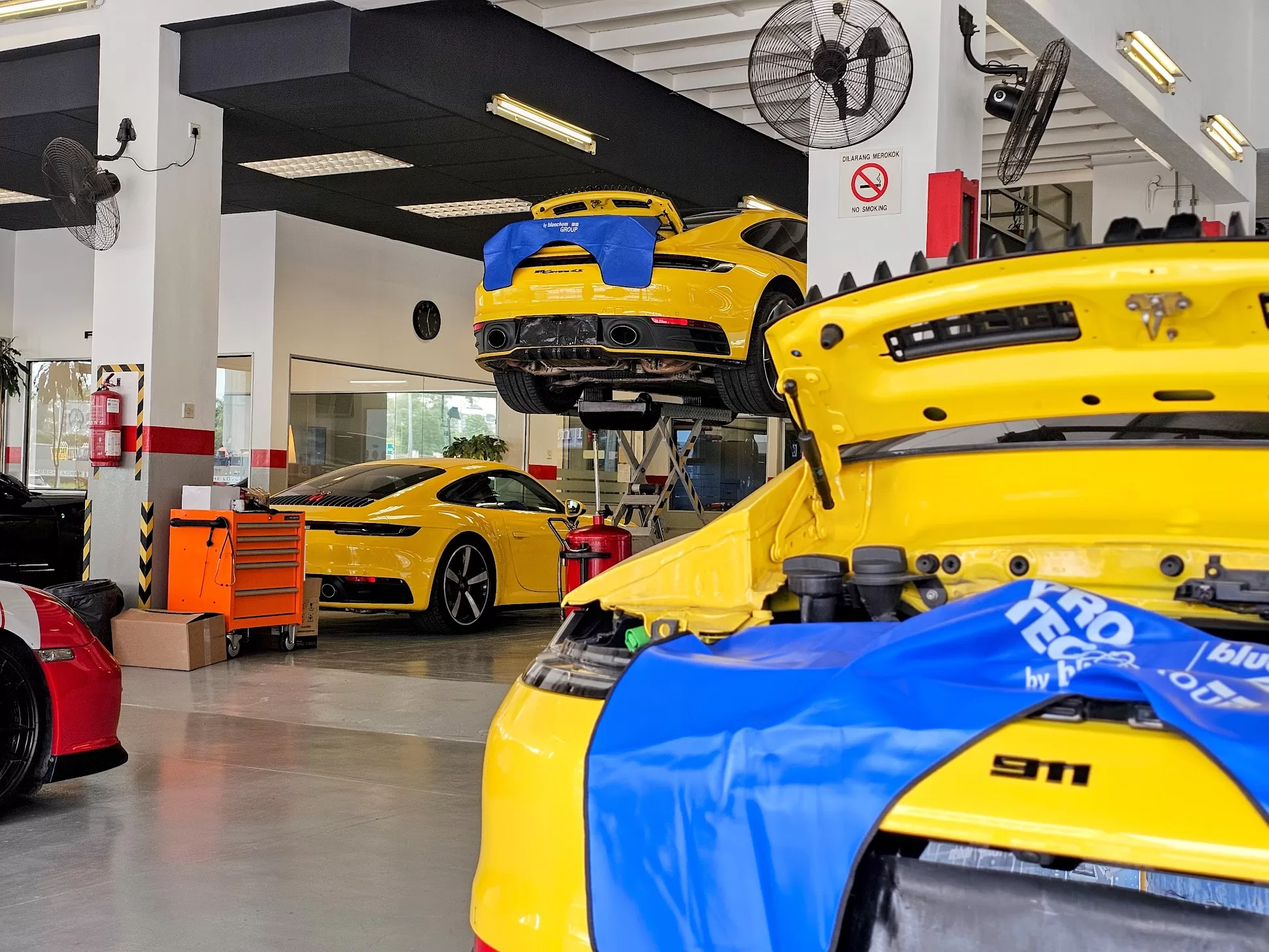
High-performance vehicles require controlled working environments.
Top-tier workshops operate with:
- Clean and organised service bays
- Proper handling procedures for sensitive components
- Calibrated diagnostic and measurement tools
- Strict adherence to safety protocols
Safety is directly linked to accuracy.
A controlled environment ensures that every adjustment, replacement, and calibration is executed correctly.
How Proper Servicing Restores Performance
When carried out correctly, servicing does more than maintain the car. It restores it.
A structured servicing process includes:
- Inspection of airflow and intake systems
- Verification of fuel delivery and combustion efficiency
- Transmission recalibration and adaptation checks
- Fluid replacement based on condition, not just mileage
- Full-system diagnostics to identify hidden inefficiencies
Once systems are brought back within optimal tolerances, the difference is immediate.
Throttle response sharpens. Gear shifts regain precision. The car feels aligned again.
Choosing the Right Workshop Matters
Not every workshop is equipped to handle performance diagnostics at this level.
When evaluating where to service your Porsche, prioritise:
- Experience with Porsche systems and behaviour patterns
- Access to brand-specific diagnostic tools
- Structured workflows and documentation
- Transparent communication of findings and recommendations
- A team that operates with discipline and consistency
The quality of servicing directly affects how the car performs afterward.
When Your Porsche Feels Slow, Pay Attention
Performance changes rarely happen overnight.
They build gradually, often going unnoticed until they reach a point where the difference is clear.
When your Porsche feels slow, it is not just about speed.
It reflects how closely the car is being maintained against its engineering standards.
Addressing it early keeps the process simple, controlled, and predictable.
Ignoring it allows small inefficiencies to evolve into larger issues.
Precision Requires Discipline
A Porsche is designed to operate within precise tolerances.
Maintaining that precision requires the same level of discipline in how it is serviced.
Workshops with structured processes, trained staff, and strict safety standards ensure that nothing is left to chance.
Because in performance engineering, consistency is everything.
And when everything is aligned correctly, your Porsche will never feel slow.
Since now you know everything there is to know about why your porsche feels slow, book a session with us and get it back up to speed!
