

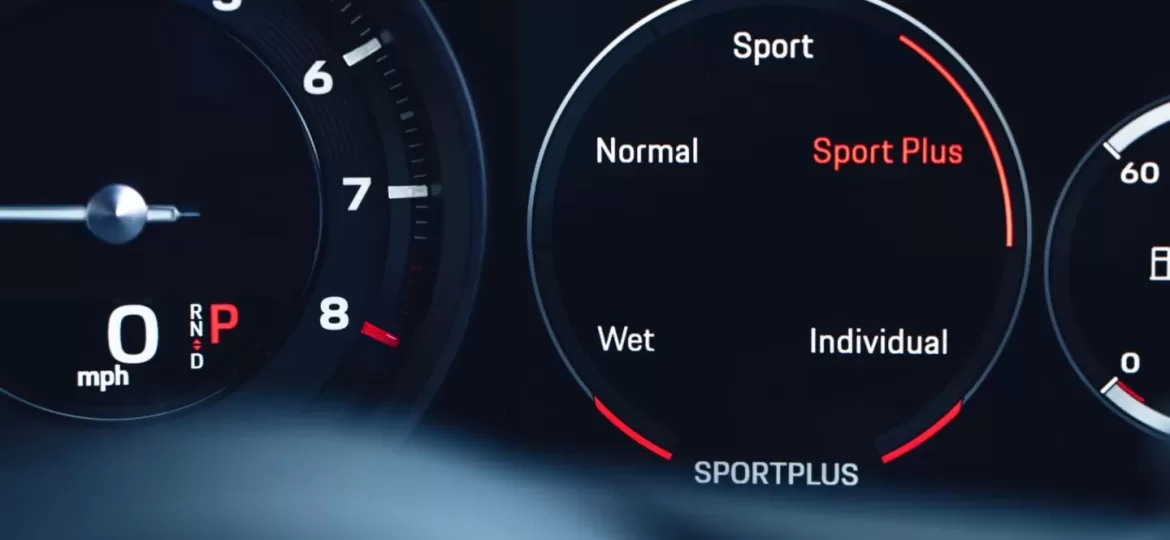
If you’ve spent any time in a modern Porsche, you’ve probably pressed the suspension button at least once.
Comfort. Sport. Sometimes Sport Plus. The car instantly feels different, but what’s actually happening underneath you?
Porsche Active Suspension Management, or PASM, is one of those systems owners talk about all the time, yet few truly understand. Some swear by Comfort mode for daily driving. Others leave it in Sport permanently. Many switch it on and off just to “feel something” without knowing what they’re feeling.
This article breaks PASM down the way owners experience it in real life. Let’s take a look at how the system behaves on actual roads, in actual traffic, and why it matters for Porsche lovers.
Key Takeaways
- PASM adapts suspension behaviour in real time to suit the road and the way you drive.
- The PASM is always active in the background. Comfort, Sport, and Sport Plus change how the system responds.
- The way PASM feels varies across Porsche models, shaped by chassis design, weight distribution, and ride height.
- PASM proves its value most on real-world roads, where changing surfaces and conditions demand constant adjustment.
- When maintained properly, PASM quietly preserves the balance, confidence, and composure that define how a Porsche should feel on the road.
What Is Porsche Active Suspension Management (PASM)?

At its core, PASM is an adaptive damping system. The keyword here is “damping”, and that distinction matters more than most people realise.
It does not change your ride height, nor does it swap springs on the fly for Porsche models that use conventional coil springs. Everything PASM does happens inside the shock absorbers, adjusting how the wheels move relative to the body.
Each damper can change its resistance in milliseconds, reacting continuously to what the car is experiencing and how it is being driven. That includes:
- Road surface quality
- Steering input
- Throttle position
- Braking force
- Vehicle speed
- Cornering load
This is not a preset “soft” or “hard” setting. PASM is always working in the background, recalculating what each corner of the car needs moment by moment to stay composed and controlled.
Comfort, Sport, and Sport Plus do not lock the suspension into fixed behaviour. They shift the baseline and adjust how quickly and assertively the system responds, which is why the car can feel relaxed one moment and tightly controlled the next without you thinking about it.
Comfort, Sport, & Sport Plus: How PASM’s Three Modes Feel on the Road

PASM’s three modes are not separate personalities. They are different attitudes applied to the same suspension, changing how much movement is allowed and how quickly the system steps in.
— Comfort Mode
Comfort mode is often misunderstood. It does not turn a Porsche into a floaty luxury sedan. Instead, it focuses on compliance while keeping the car controlled.
On real-world roads, Comfort mode:
- Absorbs sharp bumps without crashing into them.
- Reduces vertical harshness over speed humps and broken tarmac.
- Feels calmer and more settled in stop-start traffic.
What many people miss is that Comfort does not stay soft. When you brake hard or carry speed into a corner, the dampers firm up instantly. The car stays stable and connected, even when cruising. For owners who drive their Porsche daily, this is where PASM quietly proves its worth.
— Sport Mode
Sport mode tightens everything up without making the car feel stiff. The suspension firms up, body movement is reduced, and the car feels more alert and tied together.
In Sport mode, you’ll notice:
- Less body roll through corners.
- Faster, more direct response to steering input.
- Sharper and more controlled weight transfer under braking.
- A more planted feel as speeds increase.
This is the mode most drivers fall in love with on spirited runs. PASM is still adapting in the background, but it reacts faster and allows less movement before intervening. On twisty roads, the car feels like it’s bracing itself before you even finish turning the wheel.
— Sport Plus Mode
Sport Plus is where PASM stops being polite. This mode assumes aggressive driving and keeps the dampers firm most of the time. Road texture becomes much more noticeable, and sharp edges hit harder.
Sport Plus works best when:
- Roads are smooth.
- Speeds are higher.
- Steering inputs are deliberate.
- The driver is fully engaged.
On rough public roads, Sport Plus can feel tiring. It’s not bad, just honest, meaning you’ll most likely feel every bump. That’s why many experienced owners save this mode for track days or smooth highway runs. It exists for pure performance.
PASM Mode | Ride Feel | Body Control | Road Feedback | Best For |
Comfort | Composed and compliant | Stable, adaptive | Filtered but present | Daily driving, long trips, rough roads |
Sport | Firm and connected | Reduced roll and pitch | Clear and reassuring | Spirited driving, twisty roads |
Sport Plus | Very firm and uncompromising | Maximum control | Raw and unfiltered | Track use, smooth high-speed roads |
PASM modes at a glance
Is PASM the Same on Different Porsche Models?
PASM uses the same underlying technology across the range, but how it feels depends heavily on the chassis it is working with. Engine placement, weight distribution, and ride height all change the way PASM expresses itself on the road.
On a Porsche Cayman and other mid-engine cars, PASM feels exceptionally balanced. The car already has natural poise, and PASM builds on that rather than correcting flaws.
- Comfort mode works genuinely well for daily driving.
- Sport mode feels playful and engaging on back roads.
- The car stays centred and predictable, even when pushed.
Since the mass sits close to the centre, PASM’s adjustments feel subtle but very effective. The car responds cleanly without ever feeling nervous.
On a Porsche 911, PASM has a bigger job to do. With more weight over the rear axle, managing weight transfer becomes critical, especially under braking and quick direction changes.
- Sport mode noticeably tightens the rear.
- The car feels more controlled when loading up through corners.
- Transitions feel cleaner and more confidence-inspiring.
Here, PASM is less about smoothing the ride and more about keeping the chassis composed when physics start to push back.
On SUVs like the Porsche Macan and Porsche Cayenne, PASM feels almost transformative. The higher or lower ride height (depending on mode) and added mass make adaptive damping far more noticeable.
- Comfort mode genuinely smooths long-distance drives.
- Broken roads feel less tiring.
- Sport mode keeps body roll in check far better than expected.
For vehicles with this much height and versatility, PASM bridges the gap between comfort and control in a way fixed suspension simply cannot.
At the end of the day, it is the same system, but the way PASM feels changes with each Porsche model. The character is different every time, and that is exactly what makes each one special.
PASM vs. Road Quality

This is where PASM genuinely earns its reputation.
On uneven roads, fixed suspension setups struggle because they are forced to choose a compromise. Too soft, and the car feels floaty. Too firm, and every imperfection gets transmitted into the cabin. PASM avoids that trade-off by adjusting moment by moment as the road changes.
You feel the difference most clearly over:
- Patchy tarmac where grip and surface texture constantly vary.
- Broken road surfaces that would normally upset the chassis.
- Speed humps taken at different speeds, not just crawling pace.
- Long highway sections with expansion joints that cause repeated vertical movement.
In these situations, Comfort mode filters out fatigue and keeps the drive relaxed without disconnecting you from the road. Sport mode holds the body together and maintains confidence without making the car feel nervous or brittle.
That adaptability is why PASM is more than a convenience feature. Most of the time, you barely notice it because it works intuitively in the background. But once you do, usually on a rough stretch of road or a long drive, you’d be grinning ear-to-ear, having realised just how much happier you are to have it.
Does PASM Affect Maintenance?
Yes, but not in a scary way.
PASM dampers are more complex than standard shock absorbers, so there is naturally more going on behind the scenes. They cost more to replace, and they rely on proper diagnostics to assess their condition.
That said, they are engineered to last and are built to handle real-world use over time. What matters most is regular inspection and proper calibration.
When PASM is neglected, issues can start to appear gradually, such as:
- Uneven damping from side to side
- A suspension that feels inconsistent or unsettled
- Warning lights triggered by sensor or control issues
That’s why when PASM is checked as part of routine servicing, it will continue to behave exactly as Porsche intended, adapting smoothly and predictably to different driving conditions.
So… Comfy or Sporty?
Honestly? Most Porsche owners don’t really overthink PASM. They simply use it.
Day to day, it usually looks like this:
- Comfort for daily driving and imperfect roads
- Sport for weekend runs and open stretches
- Sport Plus only when conditions truly suit it
That pattern exists for a reason. PASM lets you enjoy different sides of the same car without locking yourself into one compromise. You don’t have to choose between comfort and control, or between usability and engagement. You get access to all of it, depending on how and where you drive. The system adapts, and you focus on driving.
Once you understand how PASM really behaves, it just becomes part of how your everyday life as a proud Porsche owner.
So if you want to make sure your PASM is performing the way it should, WhatsApp us at The Porsche Lover to book your next inspection or maintenance check. Sometimes, the difference between a good drive and a great one comes down to how well your suspension is doing its job.
[/vc_column_text][/vc_column][/vc_row]
